
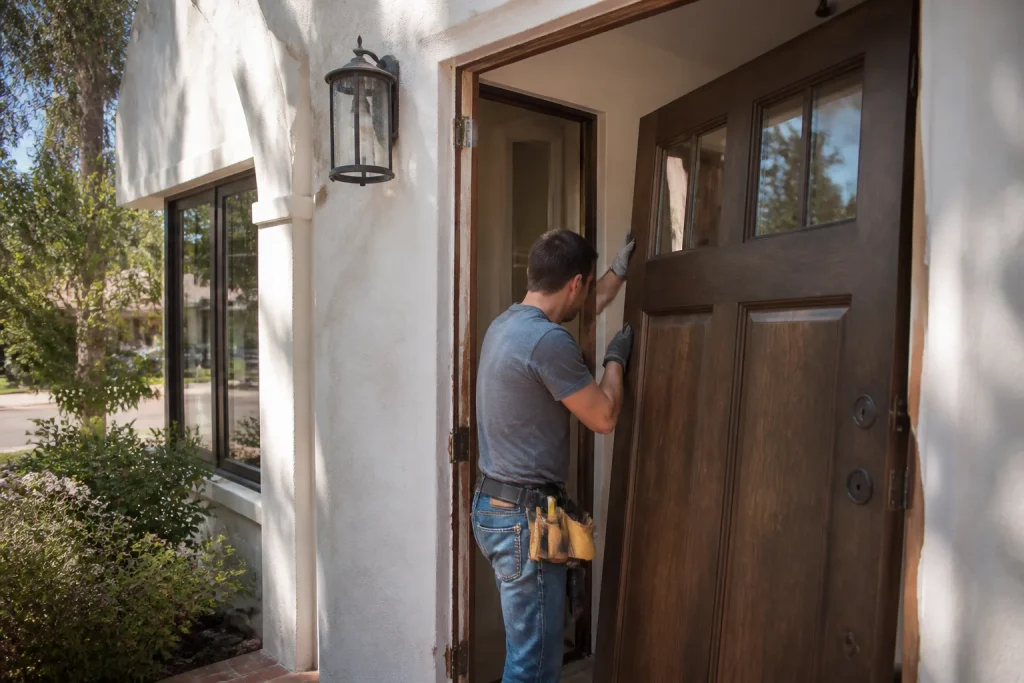
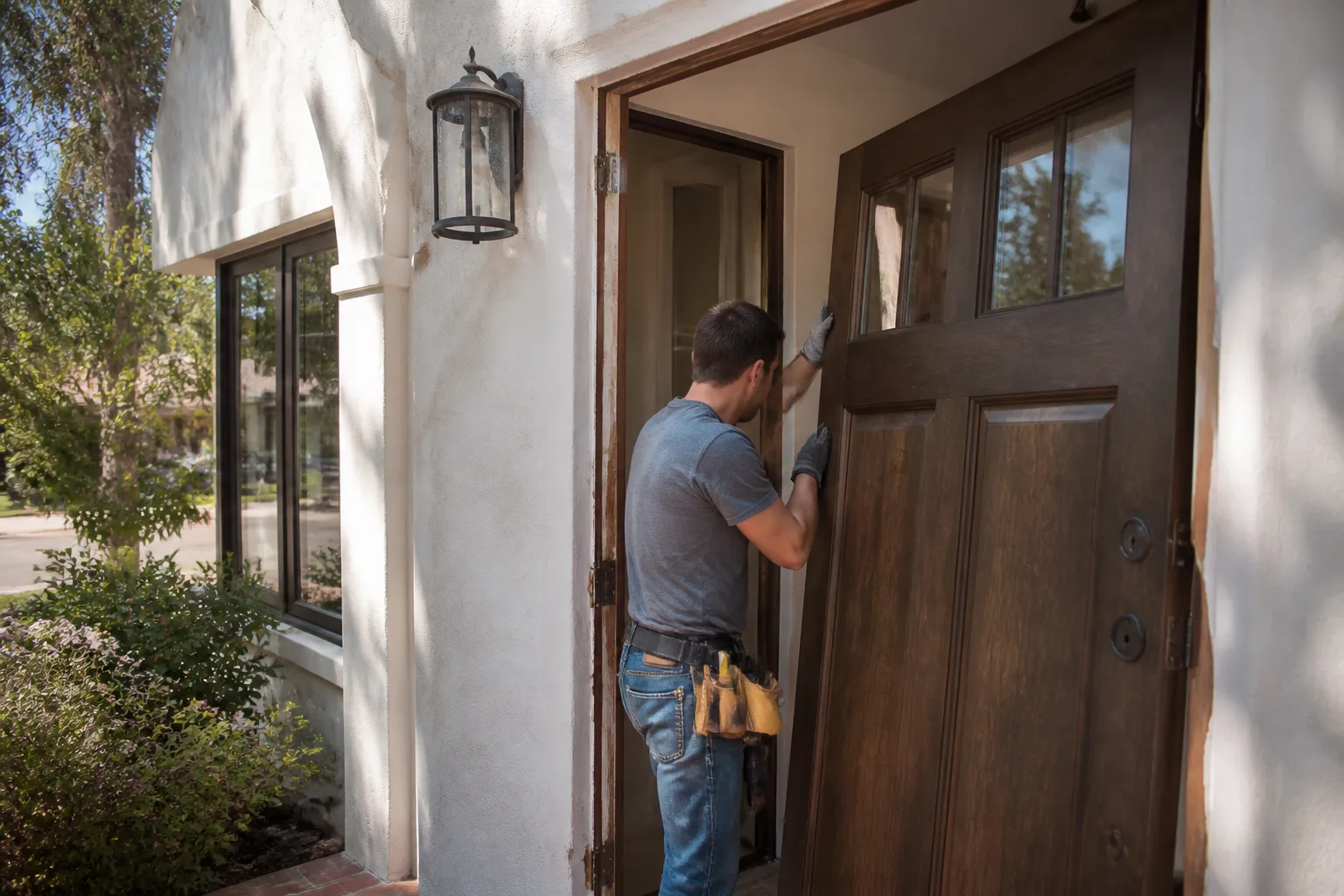
Door Replacement: Repair or Replace? How Los Angeles Homeowners Decide
Most Los Angeles doors don’t fail all at once. They fail in increments you can’t see from the street. A compression-sealed threshold loses its spring over four or five summers, the weatherstripping flattens, and suddenly your entry door is leaking conditioned air at a rate that adds $18 to $35 to your monthly power bill. The repair-or-replace question usually comes down to three hidden factors: seal failure, frame rot, and whether the door’s core can still hit current Title 24 insulation thresholds. If you’d rather skip the diagnosis and get a straight answer, call Juniper Windows & Doors at (682) 281-2168 and we’ll tell you what you’re actually dealing with.
Why Los Angeles Doors Fail in Ways You Can’t See
Los Angeles has a door problem most homeowners never notice until the dry rot is already in the jamb. Coastal fog parks itself over neighborhoods like Mar Vista, Playa del Rey, and San Pedro for weeks at a stretch between May and July. That moisture works its way into painted wood frames through hairline cracks in the caulk bead. Then the inland heat bakes it. The cycle repeats.
We’ve pulled entry doors in Westchester that looked brand new from the curb and found the bottom six inches of the frame turned to something with the structural integrity of a wet granola bar. The paint was doing all the work. That’s the thing about frame rot behind paint in LA: it doesn’t announce itself until the door starts sagging and the deadbolt stops lining up.
Then there’s the seal problem. Every exterior door relies on a compression gasket along the threshold and weatherstripping along the jambs. Those materials are rated in years, not decades. A failed threshold seal in a city where AC runs hard from June through October means you’re paying to cool air that’s already escaped into the hallway. The math isn’t dramatic month to month, but it compounds. A gap you could slide a quarter through under the door can add $200 to $400 a year to energy costs in LA, depending on your utility rate and how much direct sun the entry side gets.
The Dollar-Bill Test and Thermal Imaging: Two Ways to Check Your Door Before You Decide
Before you spend money on either path, you need to know whether your door is actually leaking. Here are the two checks we run on every Los Angeles door evaluation:
- The dollar-bill test: Close the door, slide a dollar bill into the gap between the door and the threshold or jamb, and try to pull it out. If it slides out with no resistance, the weatherstripping has lost compression. A properly sealed door should grip the bill enough that you feel drag. Do this at three points: top, latch side, and bottom.
- Thermal imaging: This one requires a $200 to $400 infrared camera or a pro with one. On a hot LA afternoon, run the camera along the interior perimeter of the closed door. A properly sealed door shows a consistent temperature profile. A leaking one shows bright streaks of heat pouring in around the sides and threshold. We’ve found gaps with a thermal camera that a dollar bill would never catch, because the leak was in the frame, not the gasket.
If the seal is the only issue and the door itself is still solid, repair is usually the right call. A replacement threshold with a new compression gasket and fresh perimeter weatherstripping runs roughly $180 to $420 in Los Angeles, parts and labor included. That’s a lot less than a new door, and it often solves 80% of the comfort complaint.
Frame Integrity: The Check That Decides Everything
This is the part where most Los Angeles homeowners skip straight to replacement, and honestly, sometimes they’re right. A frame with rot is a structural problem, not a cosmetic one. The question is how deep it goes.
Here’s how we check without tearing the jamb apart: take a flathead screwdriver and press the tip gently into the wood at the bottom corners of the jamb, on both sides. Solid wood stops the tip. Rot lets it sink in with almost no pressure. Do this along the bottom six inches and around any area where you’ve seen peeling paint or bubbling caulk. If you find soft spots in more than two locations, the frame repair will cost more than a new door by the time you factor in the carpentry work, repainting, and the recurring issue you’ll have with it down the road.
LA’s marine-layer neighborhoods are the worst for this. We worked on a house in Palms last year where the homeowner thought he needed a simple weatherstrip swap. The probe check found rot running up the hinge-side jamb nearly fourteen inches. At that point, any honest contractor tells you the same thing: you can chase frame repair, but the door’s never going to hang right, and the next marine-layer season will find the same soft wood to work on.
When Repair Pencils Out: The Narrow List
We’re not one of those companies that tells every homeowner their door is shot. Here’s the short list of situations where repair genuinely makes more sense than replacement in Los Angeles:
- Hinge realignment: If your door sticks or the latch doesn’t catch cleanly, and the frame is solid, the fix is usually a hinge adjustment or shim. This runs $120 to $250 and takes under an hour.
- Weatherstripping swap: If the dollar-bill test shows gaps but the door closes squarely and the frame probes solid, new weatherstripping and a threshold gasket is a $180 to $420 job. We do these all the time in Culver City and Jefferson Park, where the housing stock is older but the doors were built with good cores.
- Threshold adjustment: Sometimes the threshold has an adjustment channel that’s slipped. Re-leveling it and replacing the compression insert is a $100 to $200 fix.
- Hardware replacement: A deadbolt or handle set that’s worn out is $150 to $400, depending on finish and brand. The door itself doesn’t need to go anywhere.
When the core construction is the problem, though, repair is throwing money at a door that’s already done. A hollow-core door that’s been soaked, a metal door that’s rusting from the inside out at the bottom rail, a wood door with delaminating veneer: none of those get better with new weatherstripping. That’s when replacement is the honest answer, and in LA, a good mid-range replacement door from a line like Therma-Tru or Mr-Glass starts around $1,100 to $1,800 installed.
Title 24, ADA Thresholds, and the LA Code Triggers Nobody Mentions
Here’s where Los Angeles gets specific. When a door replacement crosses into structural territory, you’re no longer in cosmetic territory, and permits enter the conversation. Most exterior door replacements in a single-family home don’t require a permit if you’re swapping like-for-like in the same rough opening. But there are triggers.
If your door is wider than 36 inches, you may be looking at a replacement that needs to meet current header requirements. If the jamb is rotted enough that the rough opening needs rebuilding, the work now involves framing, and that’s a permit in most LA County jurisdictions. And if the door serves an accessible entry, the threshold height matters: current standards call for a maximum threshold height of half an inch, or three-quarters of an inch with a bevel. Older LA homes frequently have thresholds an inch and a half or two inches tall. A replacement that lowers that threshold to compliant height is a real accessibility improvement, and it’s one of the reasons an older door replacement can materially change how a house functions.
Title 24 insulation requirements also matter. The energy code in California sets minimum U-factor standards for exterior doors based on climate zone. Most of Los Angeles sits in climate zones 6, 8, and 9, and an older door with a single-pane glass insert or a degraded foam core simply won’t meet the current bar. That’s not a reason to replace on its own, but if you’re already replacing, it’s why you should ask what the new door’s U-factor actually is. A solid Therma-Tru entry door with a proper core will come in around 0.17 to 0.20. An old hollow door might be 0.50 or worse. That’s the difference between a door that insulates and one that’s basically a framed hole in the wall.
How a Written Quote Separates Repair Scope from Replacement Scope
This is where the process gets really interesting, and it’s the part most Los Angeles homeowners never see until they’re standing there with a contractor who suddenly “found” more damage. Here’s how Juniper Windows & Doors handles it, and why it matters to the repair-or-replace decision:
We put every door evaluation in writing before any work starts. If we recommend repair, the written quote lists exactly what gets repaired: hinge, threshold, weatherstripping, hardware. If we recommend replacement, the written quote lists the door, the frame work, the haul-away, the hardware, and the installation. Nothing gets added mid-job without a separate written change order that you approve. That’s the whole point of the written price commitment.
This matters to you because it removes the incentive problem. A contractor who gets upsold on replacement earns more, so vague quotes create a structural bias toward “you need a new door.” A written, line-item quote removes that bias: either the repair fixes it or it doesn’t, and if it doesn’t, you’re not out the cost of a door you didn’t need. We’ve recommended repairs on doors other companies wanted to replace. It’s not always what the homeowner expects, but it’s the honest answer, and honesty is the only thing that builds a repeat customer in this city.
If you’re not sure which camp your door falls into, Door Replacement in Los Angeles is our deep-dive page on replacement costs, timelines, and materials. And if the problem turns out to be windows, which happens more often than you’d think when someone calls about a drafty entry, check out Window Replacement in Los Angeles or Window Installation in Los Angeles – same written-quote process, same no-hassle pricing, applied to the whole opening.
The Bottom Line
Here’s what to remember when you’re deciding whether to repair or replace a door in Los Angeles:
- Check the seal first. The dollar-bill test costs nothing and tells you more than most salesmen will.
- Probe the frame. Two or more soft spots in the bottom six inches of the jamb means replacement, not repair.
- Repair is the right call for hinge issues, weatherstripping, threshold adjustment, and hardware: $100 to $420 covers most of it.
- Replacement is the right call when the core is compromised, the frame is rotted, or the door can’t meet current Title 24 standards.
- Get a written quote that separates repair scope from replacement scope. You should never have to guess what a contractor is actually going to do.
If you’re in Los Angeles and need help figuring out which side of the line your door falls on, Juniper Windows & Doors offers free estimates. Call (682) 281-2168 and we’ll send a background-checked, uniformed technician to run the same checks I’ve described here. Every job gets a written price before any work starts, backed by our 365-Day Done Right Promise: if it’s not right, we make it right, parts and labor, in writing. You can also book through our site at Juniper Windows & Doors home and get a live arrival time you can track, before-and-after photos of the work, and a digital invoice you can pay from your phone.
Frequently Asked Questions
Most door repairs in Los Angeles run between $100 and $420 depending on the scope. A threshold adjustment or hinge realignment is on the lower end at $100 to $250. A full weatherstripping swap with a new compression gasket runs $180 to $420. Call (682) 281-2168 for an exact quote on your specific door – estimates are free, and we put the number in writing before any work starts.
Run the dollar-bill test to check the seal, and probe the bottom corners of the jamb with a flathead screwdriver to check for rot. If the frame is solid and the only issue is the seal or hardware, repair is usually sufficient. If the frame has soft spots or the door core is compromised, replacement is the better long-term call. Our techs run both checks on every evaluation and give you a written recommendation – not a sales pitch.
No. At Juniper Windows & Doors, every job gets a written price before any work begins. If something changes, you approve a separate written change order before we proceed. No surprise invoices, no scope creep, no “we found this while we were in there” upcharges. That’s the standard, and it’s in writing on every project.
A standard door replacement takes one day in most cases. Pre-hung units go faster, while custom sizing or atypical rough openings may add a second day for carpentry and trim work. We give you a specific timeframe in your written quote, and we hit it. Call (682) 281-2168 for a free estimate and a real schedule.
Written by Sean Mackey, Owner at Juniper Windows & Doors, serving Los Angeles since 2001.
Need Windows & Doors Help?
Call Juniper Windows & Doors - licensed & insured, here with fast after-hours help in Los Angeles.
(682) 281-2168